
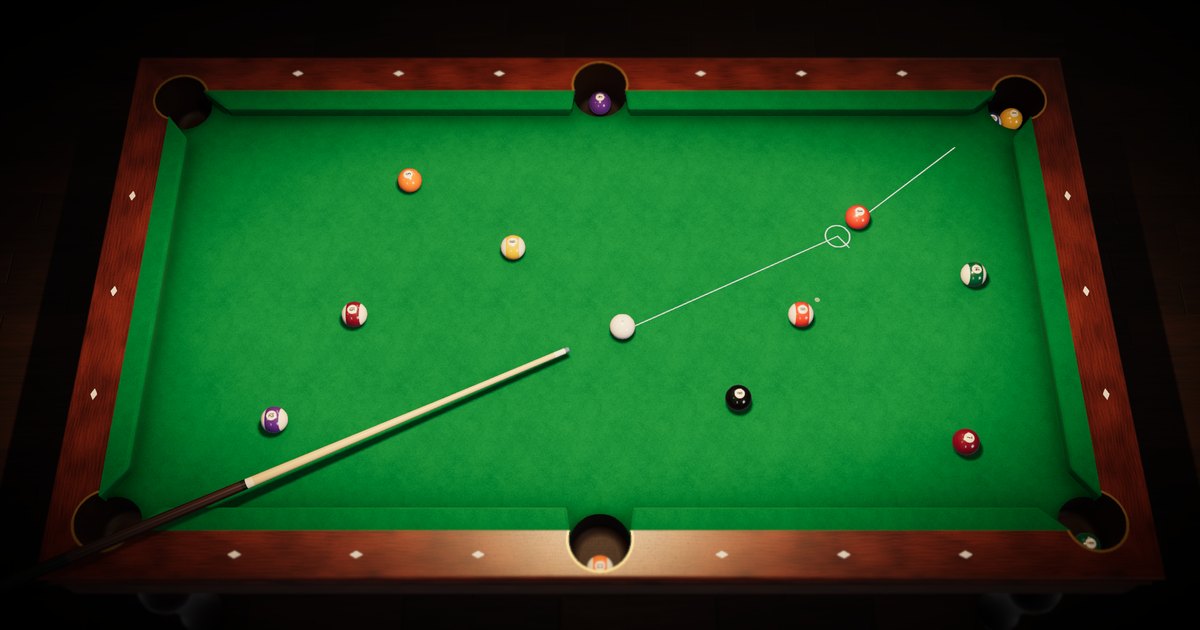
What is 8-ball?
8-ball is the pool game you find on almost every bar table. Two players, 15 numbered balls and the white cue ball: balls 1 to 7 are the solids, 9 to 15 the stripes, and in between sits the black 8. Whoever pockets all balls of their group first and then sinks the 8 in the called pocket wins.
It sounds like it is all about potting, but it is mostly about position. Where does the cue ball go after the shot? Which ball blocks a pocket you will need later? And when is a careful shot smarter, one that leaves your opponent nothing easy?
Here one fixed set of house rules applies: the common 8-ball rules with three simplifications, so the game stays quick on a phone, too. You never call your own balls, only the pocket for the 8 — and the game suggests that one for you. There is no score: all that counts is who sinks the 8.
How to play pool here
You see the table from above, with no sliders around it: you aim, draw back and shoot right on the table.
Aim
Tap a ball or anywhere on the table and the cue points there. Drag with your finger or the mouse and it turns around the cue ball — drag slowly for fine adjustments. A thin line and a ring show where the cue ball will hit; the ring turns red when that would be a foul.
Draw back and shoot
Put your finger on the cue ball or the cue and pull back like a slingshot: the further, the harder. Let go to shoot. Moving back to where you started, a second finger, the right mouse button or Esc cancel the shot.
Add spin
In the bottom right corner sits a small cue ball. Press it and drag the red dot to where the cue should strike: top for follow, bottom for draw, left or right for side spin. A double tap resets it; after every shot it is back in the centre.
In the start menu you pick your opponent: a bot (easy, normal or hard) or a second human sharing your device. With ball in hand you simply drag the cue ball to its spot and then draw back on the cue itself, and on the 8 you tap the marker of the pocket you want to call. A game in progress is saved in your browser automatically, so you can pick it up again later.
To play with friends, create a lobby and share the invite link, the QR code or the six-character code. Two play, everyone else watches, and if you are on your own you can bring a bot to the table. Everybody sees every aim and every shot live. To keep the game moving, every shot has 45 seconds; when the clock runs out, it counts as a foul.
On a computer everything works with the keyboard, too: the left and right arrow keys turn the cue (hold Shift for fine steps), up and down set the power, Space or Enter shoots. W, A, S and D add spin, X resets it, Tab jumps to the next ball you may play, P changes the called pocket, and B picks up the cue ball when you have ball in hand. In the settings you choose the aim aid (on, short or off) and adjust sound, graphics quality and — on Android devices — vibration.
The house rules
One fixed rule set for every game: the common 8-ball rules with three simplifications. There are no options — the same rules apply on a phone, on a computer and in the lobby.
The goal
After the break each player takes a group: solids (1–7) or stripes (9–15). Once you have pocketed all seven of your balls, you play the 8. Sink it legally in the called pocket and you win. One rack is one game, and there is no score.
The rack
The 15 balls are racked in a triangle of five rows, the apex ball on the foot spot and the 8 in the middle of the third row. The two back corners hold one solid and one stripe, all other balls are placed at random — every rack is shuffled anew.
The break
The breaker places the cue ball anywhere in the kitchen — the quarter of the table behind the head string — and shoots into the rack. Nothing is called.
The break is legal if a ball drops or at least four balls touch a cushion. Otherwise the balls are racked again and the opponent breaks. If a ball drops on a legal break without a foul, the breaker stays at the table; the table is still open.
If the 8 drops on the break, that is neither a win nor a loss: it goes back on the foot spot (or as close behind it as there is room) and play goes on. A foul on the break gives the opponent ball in hand in the kitchen — they then have to play out past the head string.
In a rematch on one device the other player breaks. Online, the break is drawn by lot for every game.
Open table and groups
After the break the table is open: you may hit any ball except the 8 first. The first ball you then pocket legally decides the groups — if several drop, the one that drops first counts. Balls pocketed on the break do not decide anything yet.
You never call your own balls: every ball of yours that drops on a legal shot counts, whichever cushion or ball it takes on the way.
A legal shot
The cue ball has to hit a ball of your group first — on an open table any ball except the 8, and once your group is cleared, the 8. After that a ball has to drop or any ball has to touch a cushion. A ball that already lies against a cushion and is pressed into it by the shot counts as touching it.
If you legally pocket one of your balls, you stay at the table; otherwise it is your opponent’s turn. Your opponent’s balls that drop along the way stay down.
Fouls and ball in hand
A foul ends your inning and gives your opponent ball in hand: they place the cue ball anywhere on the table and may move it again until they shoot. Balls pocketed on a foul stay down; balls that jump off the table stay out. All fouls are listed under fouls at a glance.
8-ball has no three-foul rule.
The 8
Once your group is cleared, you play the 8 and call its pocket. The game picks the pocket your 8 is heading for right now; tap another pocket marker and that one counts.
If the 8 drops in the called pocket on a legal shot, you win. You lose if it drops too early (even together with your last ball), in another pocket, on a foul, or if it jumps off the table.
When nothing drops
If no ball drops for 40 shots in a row, the balls are racked again and whoever broke the last rack breaks again. Online every shot has 45 seconds; when the clock runs out, that is a foul and your opponent gets ball in hand.
Balls and groups
15 numbered balls and a white one: colour and stripes tell you at a glance whose ball it is.
| Balls | In the game |
|---|---|
| Solids (1–7) | Balls of one colour: 1 yellow, 2 blue, 3 red, 4 purple, 5 orange, 6 green, 7 maroon. Whoever plays them pockets all seven and then the 8. |
| Stripes (9–15) | White balls with a wide band in the same colours, from the yellow 9 to the maroon 15. The same goes for them as for the solids. |
| The 8 | Black. It belongs to nobody: you only play it once your group is cleared, and then it decides the game. |
| The cue ball | The white ball. It is the only one you strike with the cue; after a foul your opponent takes it in hand. |
The bar at the top shows which group you play: a small solid or striped ball, “Open table” before that and the 8 at the end. Next to it, seven small squares stand for your balls still on the table.
Advertisement
Fouls at a glance
Every foul costs the same: it is your opponent’s turn, with ball in hand.
| Foul | When it happens |
|---|---|
| Scratch | The cue ball drops into a pocket. |
| Cue ball off the table | The cue ball jumps over the cushion. |
| No ball hit | The cue ball misses every ball. |
| Wrong ball first | The cue ball hits one of your opponent’s balls first — or the 8 while the table is open or your group still has balls. |
| No cushion | After the first contact no ball drops and no ball touches a cushion. A ball already against a cushion that is pressed into it counts as touching it. |
| Ball off the table | A ball jumps off the table; it stays out. |
| Not out of the kitchen | With ball in hand in the kitchen, the cue ball first hits a ball that also lies in the kitchen without having crossed the head string before. |
| Time’s up | Online only: the clock for your shot runs out after 45 seconds. |
After a foul your opponent places the cue ball with ball in hand anywhere on the table, after a foul on the break only in the kitchen. A ring around the cue ball shows that it may be moved; it cannot be put on top of another ball.
Several fouls on one shot count once. The hint line at the top names the reason, with a red square in front.
How the 8 decides the game
| Win | The 8 drops in the called pocket on a legal shot after your group is cleared. |
|---|---|
| 8 too early | The 8 drops before your group is cleared — even together with your last ball. You lose. |
| 8 in the wrong pocket | The 8 drops in another pocket than the one you called. You lose. |
| Foul on the 8 | The 8 drops but the shot is a foul, for example because the cue ball follows it in. You lose. |
| 8 off the table | The 8 jumps off the table. You lose. |
Table, balls & physics
To make every shot feel like the real thing, the game works with the measurements and the friction of a real bar table.
You play on a seven-foot bar table: 1.98 × 0.99 m of cloth between the cushions (78 × 39 inches), six pockets with 118 mm openings in the corners and 137 mm at the sides. The balls measure 57.15 mm across and weigh 170 g; the cushions strike them a little above their centre, just as on a real table.
Every shot is worked out in steps of 1 ms: the cue ball first slides across the cloth and then starts to roll, spin keeps working after contact, balls drag each other along a little when they collide, and every cushion swallows part of the pace — about 70 % comes back. A ball rolling at 1 m/s travels about 5.1 m before it stops.
The maths is the same everywhere: online the server simulates every shot, and every device replays it ball by ball exactly the same way. What you see is what your opponent sees.
- Table
- 7 ft · 1.98 × 0.99 m
- Pockets
- corner 118 mm · side 137 mm
- Balls
- 15 + cue ball · 57.15 mm · 170 g
- Cushion height
- 36.3 mm · 63.5 % of a ball
- Kitchen
- last quarter · 50 cm
- Hardest shot
- 11 m/s · 40 km/h
- Spin
- up to 14 mm off centre
- Diamonds
- 18 on the rails
Drawing back sets the power: a short pull gives a gentle shot, a full pull a break at about 40 km/h. Most shots need less than half.
Tips & strategy
Potting is half the job. The other half is where the cue ball ends up.
Look before you shoot
Before each shot, check which of your balls will drop easily and which will cause trouble: a ball against a cushion, two balls touching, a ball sitting in front of a pocket you need. Deal with the hard ones early, while you still have easy balls to keep going.
Steer the cue ball
Spin decides where the cue ball goes after contact: with follow (dot at the top) it rolls on, with draw (dot at the bottom) it comes back, and a centre hit at low pace leaves it almost where it was. Plan to have the next ball straight in front of you.
Smooth beats hard
Hard shots forgive less: the ball is more likely to rattle out of the pocket, and the cue ball flies across the whole table. A smooth shot at medium power is usually the better choice — save the full pull for the break.
Keep an eye on the 8
Do not leave the 8 where it is hard to pocket, and play your last ball so that the cue ball ends up with a good angle on the 8. If the 8 is stuck on a cushion, free it early with one of your balls.
Play safe when you must
When nothing is on, a careful shot is often smarter: hit one of your balls, make sure something reaches a cushion, and leave the cue ball where your opponent has no easy ball. A foul, on the other hand, hands them ball in hand.
Practise with the bots
“Easy” aims loosely and mostly pockets the simple balls. “Normal” makes most straight shots. “Hard” aims precisely, cares where the cue ball stops and avoids shots that could send it into a pocket.
Advertisement
Pool FAQ
Can I play pool here for free?
Yes. Pool on The Usuals is completely free — no sign-up, no download and no in-app purchases. It runs right in your browser, on your phone or computer.
How do I play pool online with friends?
Click “Play with friends”, choose a name and create a lobby. Share the invite link, show the QR code or read out the six-character code. Two play, everyone else watches and sees every shot live.
Can I play alone against the computer?
Yes. Play solo against a bot (easy, normal or hard). The bots shoot under the same rules and with the same physics as you.
Can two people play on one device?
Yes. In the start menu pick a second player instead of a bot. You take turns on the same phone, tablet or computer; the bar at the top shows whose turn it is.
Which rules do you play?
The common 8-ball rules with three simplifications: you never call your own balls, only the pocket for the 8 — and the game suggests that one. After a foul your opponent gets ball in hand anywhere on the table. All the details are in the house rules.
What happens if the 8 drops on the break?
Nothing bad: it goes back on the foot spot and the game goes on. You can only win or lose with the 8 after the break.
Why is there no score?
Because 8-ball does not need one: whoever sinks the 8 legally wins the game. The bar at the top shows which group you play and how many of your balls are left.
How do I put spin on the cue ball?
With the small cue ball in the bottom right corner: press it, drag the red dot where you want the cue to strike and let go. Top gives follow, bottom gives draw, left and right give side spin. On a computer the keys W, A, S and D work too; X resets the spin.
How real is the physics?
Pretty real. The game uses the measurements of a seven-foot bar table, balls weighing 170 g and the friction of the cloth, the cushions and the balls against each other. The cue ball slides, rolls and takes spin just like on a real table. More under table, balls & physics.
Does pool work on my phone?
Yes, the controls are made for touchscreens: tap to aim, pull back like a slingshot, let go to shoot. In portrait the table runs along the screen, in landscape across it. On older devices a lower graphics quality in the settings helps, down to 2D with no 3D graphics at all; where 3D does not run, the game starts in 2D by itself.